

CG Policy · 2025
In this section7 topics
Corporate Governance Policy
Has a Corporate Governance Policy
Yes
Policy Description
As a leader in the lifestyle mobility industry driven by innovation and customer-centricity listed on the Stock Exchange of Thailand, Millennium Group Corporation is committed to conducting business in compliance with the principles of good corporate governance, transparency, and accountability to generate potential and sustainable growth for the Company's business ecosystem.
For this reason, the Board of Directors has approved good corporate governance policies and business ethics, which are reviewed on a regular basis and improved annually to ensure compliance with the law, the eight corporate governance principles (Corporate Governance Code: CG Code), business operations, economic environment, and the changing society. These good corporate governance policies and business ethics are communicated to the board, executives, and all employees, and must be strictly followed as the practice, guidelines, and norms for conducting business. In addition, to improve compliance with the organization's business ethics at all levels and acquire the trust of shareholders, investors, and all stakeholders, the Company has published the corporate governance policies, business ethics, and other relevant policies on the website www.mgc-asia.com.
In this regard, the Board of Directors has assigned the Risk Governance and Sustainability Development Committee to oversee and review matters related to corporate governance and sustainability development. This includes monitoring outcomes, reviewing, and further developing policies to ensure their appropriateness in response to prevailing circumstances and alignment with good corporate governance practices. The Corporate Governance policy covers five sections as follows:
Section 1 The Rights of Shareholders
Section 2 The Equitable treatment of Shareholders
Section 3: The Role of Interested Persons
Section 4: Disclosure and Transparency
Section 5: Responsibilities of the Board of Directors
Policy Document Link
https://www.mgc-asia.com/en/investor-relations/corporate-governance/policy
Policy & Practices — Board of Directors
Has Policy & Guidelines for the Board
Yes
Board Guidelines
| Guideline | Other — Please Specify | Detail | Document Link | Page Number in Report | ||||||||||||||||||||||||||||||||||||||||||||||||||||||||||||||||||||||||||||||||||||||||||||||||||||||||||||||||
|---|---|---|---|---|---|---|---|---|---|---|---|---|---|---|---|---|---|---|---|---|---|---|---|---|---|---|---|---|---|---|---|---|---|---|---|---|---|---|---|---|---|---|---|---|---|---|---|---|---|---|---|---|---|---|---|---|---|---|---|---|---|---|---|---|---|---|---|---|---|---|---|---|---|---|---|---|---|---|---|---|---|---|---|---|---|---|---|---|---|---|---|---|---|---|---|---|---|---|---|---|---|---|---|---|---|---|---|---|---|---|---|---|---|---|---|---|
| Nomination of Directors | Selection of Directors and Independent Directors The Nomination and Remuneration Committee is responsible for considering, selecting, and recruiting individuals with the appropriate qualifications, experience, knowledge, and skills to contribute effectively to the business operations of the Company. These individuals are nominated to become directors and independent directors, to be proposed for approval by the Board of Directors and subsequently by the shareholders' meeting, in accordance with the Company’s Articles of Association. In the selection process of new directors, the Nomination and Remuneration Committee ensures that candidates meet the qualifications as outlined in the Board Charter and are evaluated based on the Board Skill Matrix, which has been approved by the Board of Directors. The criteria for selection align with the Company’s business strategy and are reviewed annually. Furthermore, the Committee considers the diversity of qualifications, including factors such as gender, age, ethnicity, religion, nationality, and country of origin (Board Diversity). This approach promotes equality and prevents discrimination in the selection process. The Committee also utilizes the Director Pool provided by the Thai Institute of Directors Association (IOD) to assist in identifying suitable candidates. In the previous year, the Company granted shareholders the right to propose candidates they believe are qualified for election as directors. This was announced on the Company’s website. However, no shareholder submitted any nominations for the election of new directors. In cases where a director’s position becomes vacant for reasons other than the expiration of the term, the Board of Directors will consider the appointment of a suitable candidate who meets the necessary qualifications and does not have any legal prohibitions. The appointment will be made with at least three-quarters (3/4) majority of the remaining directors. The newly appointed director will serve only for the remaining term of the director who vacated the position. For the selection of independent directors, the Company will consider candidates who meet the qualifications of independent directors as defined by the Company and in line with the Capital Market Supervisory Board regulations, as well as criteria set by the Securities and Exchange Commission (SEC) and the Stock Exchange of Thailand (SET). The qualifications of independent directors are based on the guidelines set forth in the Capital Market Supervisory Board’s announcement. For further details, please refer to Appendix 5 under the section titled "Board Charter of the Company". Selection of Chief Executive Officer and Senior Executives In the event that the position of Chief Executive Officer (CEO) or a senior executive becomes vacant, or the incumbent is unable to fulfill their duties, the Board of Directors will designate the most qualified and suitable executive from the next-in-line or an equivalent position as an interim acting officer until a permanent successor is appointed. The Nomination and Remuneration Committee is responsible for determining the criteria and qualifications for selecting a new CEO or senior executive. The selection process focuses on identifying individuals with the appropriate expertise, leadership vision, and deep understanding of the corporate culture, ensuring their ability to drive the Company’s business strategy and sustainable growth. The Committee will propose the most qualified candidate to the Board of Directors for consideration and approval. Succession Plan for the Chief Executive Officer and Senior Executives The Board of Directors recognizes the critical importance of establishing a structured succession planning framework to ensure leadership continuity in the event of a planned or unplanned transition of key management personnel. This initiative aims to mitigate risks associated with leadership gaps and ensure that the Company maintains its operational stability, strategic direction, and long-term competitiveness. The Nomination and Remuneration Committee is responsible for developing and maintaining the succession plan for the CEO and senior executives, which is submitted to the Board of Directors for review on an annual basis. The succession planning process adheres to the following key principles and governance standards: Assessment Criteria
Employees who pass the assessment and are identified as successors will receive appropriate development to prepare them for future leadership roles within the organization. In this regard, the Company gives first consideration to internal candidates. If no suitable successor can be identified from within the Company, external candidates with appropriate qualifications will then be considered. Succession Process and Procedures
Development Plan
Board Skill Matrix The Company is committed to Board Diversity, ensuring a well-balanced composition that integrates Gender Diversity, Age Distribution, Knowledge and Expertise, Professional Experience, Critical Competencies, and Industry-Specific Skills. The core areas of expertise prioritized for board composition include Automotive Industry and Business Management, Finance, Accounting, Legal, and Investment, Technology, Digital Transformation, Innovation, Governance, Risk Management, and Compliance (GRC). In the director nomination process, the Company considers a wide range of qualified candidates from diverse sources, including State Enterprise Director Pool, Professional Director Databases, such as the Thai Institute of Directors (IOD) registry. Additionally, shareholders are granted the right to nominate candidates for directorship consideration at the Annual General Meeting (AGM). The selection process is guided by the Board Skill Matrix, ensuring alignment with the company’s strategic direction and long-term value creation objectives. | https://www.mgc-asia.com/storage/document/cg-policy/board-and-committee-charter-en.pdf | ||||||||||||||||||||||||||||||||||||||||||||||||||||||||||||||||||||||||||||||||||||||||||||||||||||||||||||||||||
| Determination of Director Remuneration | The remuneration of the Company’s directors is determined based on the principles of fairness, transparency, and alignment with the scope of duties, responsibilities, and individual performance. The remuneration structure comprises fixed components (monthly retainer fees and meeting allowances) as well as variable components in certain cases, subject to the Company’s operating performance. The proposed remuneration is reviewed by the Nomination and Remuneration Committee and endorsed by the Board of Directors prior to submission for approval at the shareholders’ meeting. The remuneration structure applies to members of the Board of Directors and its sub-committees, including the Audit Committee, the Risk Management, Corporate Governance and Sustainability Committee, the Nomination and Remuneration Committee, as well as Independent Directors, the Group Chief Executive Officer, and senior executives. The determination of remuneration takes into account the nature and scope of responsibilities, performance results linked to the Company’s overall performance, and other relevant contextual factors. Benchmarking against remuneration practices of listed companies in the same or comparable industries is also conducted to ensure competitiveness and appropriateness. The Company establishes annual remuneration rates, with specific provisions for the Chairman of the Board, members of the Audit Committee, and other sub-committees, based on their assigned duties. Directors who concurrently hold executive or employee positions within the Company are not entitled to receive duplicate remuneration for their directorship roles. | |||||||||||||||||||||||||||||||||||||||||||||||||||||||||||||||||||||||||||||||||||||||||||||||||||||||||||||||||||
| Independence of the Board of Directors from the Management | The Company ensures the independence of the Board from management by maintaining a proportion of independent directors at no less than one-third of the total board members, and no fewer than three persons. The qualifications of independent directors strictly comply with the criteria set forth by the SEC and the Stock Exchange of Thailand. Independent directors must have no business or personal relationship that could compromise their objectivity. Their duty is to act with integrity and in the best interests of the Company and all shareholders. | |||||||||||||||||||||||||||||||||||||||||||||||||||||||||||||||||||||||||||||||||||||||||||||||||||||||||||||||||||
| Director Development | The Company promotes continuous learning and development of directors, covering essential knowledge areas such as corporate governance, risk management, and sustainability. Directors are encouraged to attend training programs provided by the Thai Institute of Directors (IOD) and other reputable institutions, both domestic and international. The Company also provides a structured orientation program for new directors to familiarize them with the corporate structure, business operations, strategy, and key objectives. This program is facilitated by the Chairman of the Board of Directors, Group Chief Executive Officer (Group CEO), and/or the Executive Committee. Additionally, new directors receive essential governance documents, including the Board of Directors’ Charter, Articles of Association, and the Annual Report, along with other relevant materials. These documents help ensure that new directors fully understand their fiduciary duties, roles, and responsibilities as board members. The company also encourages directors to engage in continuous professional development through executive training programs, seminars, and industry briefings to enhance their governance competencies. This ensures that directors stay up to date with evolving business dynamics, regulatory developments, and best practices, ultimately benefiting the company’s corporate governance framework. In 2025, the following directors completed director development programs: Mr. Asa Piyarat – Risk Management Program for Director Certification Program (DCP) 379/2025 Further details on board members' participation in training programs can be found in Appendix 1: "Details of Directors, Executives, Controlling Persons, Persons in charge of Finance and Accounting, Head of Controller and Company Secretary, and the Representative for Contract in Case of Foreign Company" Moreover, the Company regularly disseminates information on relevant corporate governance training and seminars to the Board. | https://www.mgc-asia.com/storage/document/cg-policy/cg-policy-en.pdf | 16-17 | |||||||||||||||||||||||||||||||||||||||||||||||||||||||||||||||||||||||||||||||||||||||||||||||||||||||||||||||||
| Board Performance Evaluation | The Company arranges for the performance evaluation and review of the Board of Directors and all subcommittees on a regular annual basis, at least once a year. The evaluation is based on the board self-assessment guidelines of the Stock Exchange of Thailand, adapted as appropriate to the Company’s board characteristics and structure. This serves as a framework for reviewing the performance of the Board’s duties and promotes collective consideration of performance outcomes, as well as issues and obstacles relating to the Company’s operations and good corporate governance. Board Performance Evaluation as a Whole The evaluation criteria are classified into five levels, as follows: 1 = Strongly disagree, or no action has been taken on the matter 2 = Disagree, or only limited action has been taken on the matter 3 = Agree, or the matter has been implemented to a reasonable extent 4 = Largely agree, or the matter has been well implemented 5 = Strongly agree, or the matter has been implemented excellently The evaluation covers six areas as follows:
Evaluation Process
Results of the Board Performance Evaluation as a Whole for 2025
Individual Director Performance Evaluation The individual director performance evaluation covers five areas:
Evaluation Process
Results of the Individual Director Performance Evaluation for 2025
Sub-committee Performance Evaluation The criteria and process for subcommittee performance evaluation are as follows:
The performance evaluation results of the subcommittees are as follows: Audit Committee
Nomination and Remuneration Committee
Risk Governance and Sustainability Development Committee
Executive Committee
Performance Evaluation of the Top Executive The Company requires the performance evaluation of the top executive to be conducted annually to ensure alignment with the Company’s business goals, organizational strategy, and principles of good corporate governance. The Board of Directors uses the evaluation results as an important tool for monitoring management effectiveness and ensuring that the top executive is able to drive the organization toward the achievement of both short-term and long-term goals in an effective and sustainable manner. The performance evaluation of the top executive is divided into four sections: (1) financial performance indicators, (2) management performance indicators, (3) people management indicators, and (4) environmental, social, and governance (ESG) indicators. The evaluation covers both quantitative and qualitative performance outcomes in order to reflect the overall effectiveness of organizational management.
In 2025, the top executive received an overall evaluation score of 95.04, reflecting strong capability in managing and driving the organization toward its established objectives effectively across financial performance, organizational management, human resource development, and business operations under the framework of good corporate governance and sustainable development principles. | |||||||||||||||||||||||||||||||||||||||||||||||||||||||||||||||||||||||||||||||||||||||||||||||||||||||||||||||||||
| Corporate Governance of Subsidiaries and Associated Companies | The Company implements robust oversight of its subsidiaries and associated companies. Directors or executives of the Company are appointed to serve on the boards of such entities to ensure strategic alignment and compliance with the Company’s policies and Code of Conduct with clear scopes of authority and responsibilities are defined for board representatives, and any material transaction or matter must be approved by the Company’s Board of Directors prior to execution. Any other terms not mentioned in this document are subject to the securities and stock exchange laws, including other laws applicable or related to the Company's operation. (1) In the following cases, directors of subsidiaries or associated companies (as the case may be) who represent the Company must be approved by the Board meeting before they can vote in Board meetings of subsidiaries or associated companies (as the case may be) to do such actions: (1.1) Appointing or nominating individuals to be directors and executives representing the Company in subsidiaries and associated companies at the appropriate shareholding proportion of the Company in the subsidiaries or associated companies Except for when the governance policies of the subsidiaries and associated companies or the Board of Directors of the Company determine otherwise, the directors and executives appointed or nominated by the Company have the discretion to vote at board meetings of the subsidiaries and associated companies on general management issues and normal business transactions of subsidiaries and associated companies as the said committees or directors deem appropriate for maximum benefit of the Company and the subsidiaries or associated companies (as the case may be). There are, however, some exceptions for issues that require approval from the Company's Board or the Annual General Shareholders' Meeting. (1.2) Capital increase by issuing additional shares of the subsidiaries or associated companies and share allocation: This principle also applies to reducing the registered capital of subsidiaries or associated companies which are not proportionate with the existing proportion held by shareholders or any other action that may decrease direct or indirect voting right of the Company at general meetings of shareholders of the subsidiaries or associated companies or decrease the shareholding proportion that falls within the scope of selling assets to the extent that requires approval from the Company's Board meeting. However, there is an exception if it is part of the annual business plan or budget plan of the subsidiaries or associated companies that has been approved by the Company's Board meeting. (1.3) Approving the annual dividend payment or interim dividend payment (if any) of the subsidiaries or joint ventures, with an exception for cases where such dividend payments align with the determined policy of the subsidiaries or associated companies; (1.4) Changing regulations of the subsidiaries or associated companies, with an exception for significant changes in the regulations, which demand approval from the Company's Board meeting; (1.5) Approving annual budget of the subsidiaries, except when specified in the line of authority of the subsidiaries, which has been approved by the Company's Board meeting The following actions are significant and fall into the scope that may significantly affect the financial status and business performance of the subsidiaries. Therefore, these actions require approval from the Company's Board. It should be noted that these actions must be considered when calculating the size of the transactions by the subsidiaries compared to the size of the Company, and the results reach the threshold that needs approval from the Company's Board meeting.
1.1 In case the subsidiaries enter into agreements with individuals related to the Company or subsidiaries or transactions related to the acquisition or disposal of assets of the subsidiaries: (1) Transfer or waiver of benefits, including the waiver of claims against those who have caused damage to the subsidiary. (2) Sale or transfer of all or a significant part of the subsidiary's business to another party. (3) Purchase or acquisition of another company's business into the subsidiary. (4) Entering into, amending, or terminating contracts related to leasing all or a significant part of the subsidiary's business, assigning another party to manage the subsidiary's business or merging the subsidiary's business with another party. (5) Leasing or lease-purchasing all or a significant part of the subsidiary's business or assets. 1.2 Engaging in borrowing, lending, granting of credit facilities, providing guarantees, incurring financial obligations, or extending any form of financial assistance that results in a material financial liability for the subsidiary and is not in the ordinary course of business, except for intercompany loans between the Company and its subsidiaries. 1.3 Dissolution of the subsidiaries' business; 1.4 Any other transaction that is not normal business transaction of the subsidiaries and is the transaction that significantly affects the subsidiaries; (2) Before the subsidiaries make the following transactions, they must have approval from the Company's Board meeting. It should be noted that these actions must be the cases when calculating the size of the transactions by the subsidiaries compared to the size of the Company and the results reach the threshold that needs approval from the Company's Annual General Shareholders' Meeting. (2.1) In case the subsidiaries enter into agreements with individuals related to the Company or subsidiaries or transactions related to the acquisition or disposal of assets of the subsidiaries: (2.2) Capital increase by issuing additional shares of the subsidiaries and share allocation: This principle also applies to reducing the registered capital of subsidiaries which are not proportionate with the existing proportion held by shareholders or any other action that may decrease the direct or indirect voting right of the Company at general meetings of shareholders of the subsidiaries to the extent lower than the proportion stipulated by laws enforced with the subsidiaries that make the Company lose the power to control the subsidiaries. (2.3) Dissolution of the subsidiaries' business. (2.4) Any other transaction that is not a normal business transaction of the subsidiaries and significantly affects the subsidiaries; (2.5) Changing regulations of the subsidiaries on matters that may significantly affect the financial status and business performance of the subsidiaries, including but not limited to changes in the regulations of the subsidiaries that may affect the Company's right to vote at board meetings and/or general meetings of shareholders of the subsidiaries or dividend payment of the subsidiaries. (3) The Company will ensure that the board and directors of the subsidiaries and associated companies nominated or appointed by the Company assume duties and accountability by laws, regulations, and policies of the Company. (4) The Company's Board will ensure that the operational performance of subsidiaries proceeds continuously as planned and that the subsidiaries disclose information, financial statements, business performance, related party transactions, acquisition or disposal of assets, and other transactions that are significant to the Company, along with other operations to fully and strictly comply with the principles of corporate governance of subsidiaries and associated companies according to relevant notifications of the Capital Market Supervisory Board and notifications of the Securities Exchange Commission (as the case may be). (5) Directors and executives of subsidiaries and associated companies nominated or appointed by the Company have the following duties. (5.1) Disclose financial status and performance, related party transactions, and acquisition or disposal of assets that are significant to the subsidiaries to the Company's Board and directors fully and accurately within an appropriate timeframe determined by the Company; (5.2) Disclose and submit the data of their personal gain and related individuals to the Company's Board about the relationship and transactions with the Company or subsidiaries in ways that may cause conflicts of interest. They are required to inform the Company's Board of such matters within an appropriate timeframe as determined by the Company to supplement decisions or approvals primarily based on the overall benefit of the Company or subsidiaries. They are not allowed to take part in approving matters in which they have gained and loss or conflicts of interest, either direct or indirect. (5.3) Report on the business operation plan, business expansion plan, large investment projects as approved by the Company, business downsizing, business dissolution, stopping the operation of some departments, co-investing with other businesses to the Company through the monthly or quarterly business performance report and providing explanations or submitting documents for such matters as requested by the Company; (5.4) Explain and/or submit documents related to business operations to the Company as requested; (5.5) Explain and/or submit documents to the Company in case the Company finds significant issues. (6) In case subsidiaries or associated companies consider appointing accounting auditors, the directors or executives of the subsidiaries or associated companies nominated or appointed by the Company should inform the subsidiaries or associated companies that they should appoint accounting auditors who are full members in the same audit firm network as the auditors of the Company. (7) The Company's Board must ensure that the subsidiaries have an internal control system, a risk management system, and an anti-corruption system that are sufficiently strict to prevent corruption that may occur in the Company, as well as other necessary systems. A clear working system should be implemented to demonstrate that the Company has a sufficient system to disclose information and make significant transactions according to the determined criteria continuously and credibly. There should be channels for the Company's directors and executives to acquire the data of subsidiaries in order to monitor the business performance, financial status, related party transactions, acquisition or disposal of significant assets, and other significant transactions of the subsidiaries effectively. (8) It is forbidden for directors, executives, employees, or authorized individuals of the Company or subsidiaries, including their spouses and children who are not yet of legal age, to use internal information of the Company or subsidiaries (9) The Company must ensure that the directors in the subsidiaries or associated companies appointed by the Company always attend and vote as determined by the Company at board meetings of the subsidiaries or associated companies on the agendas that are significant to business operations of the subsidiaries or associated companies, except for force majeure events where the directors are unable to attend the meetings. (10) Directors, executives, or individuals related to the Company or subsidiaries may make transactions with the Company or subsidiaries (as the case may be) only when the transactions are approved by Board meeting or Annual General Shareholders' Meeting of the Company or subsidiaries, depending on the size of transactions calculated. However, there is an exception for transactions that are trade agreements in the same manner that a reasonable person would deal with a normal contracting party in the same situation with the trade power without influence from their status as directors, executives, or related individuals, as the case may be, and the transactions are trade agreements that have been approved by the Company's Board meeting or in compliance with the principles approved by the Company's Board meeting. Please see the details of the policies and guidelines related to the Company's Board of Directors in Appendix 5: Policies and Guidelines for Good Corporate Governance and Business Ethics on the topics of policies for good corporate governance, recruitment and personnel development, and policies for corporate governance of subsidiaries and associated companies. Scope of Duties and Responsibilities of the Representative Directors and Executives of the Subsidiaries and/or Affiliates Operating the Core Business The Company has established the scope of authority, duties, and responsibilities of its appointed representatives who serve as directors and/or executives in subsidiaries and/or affiliates engaged in core business activities. This framework is designed to ensure effective corporate oversight, governance, and accountability over the management and operations of such entities. Additionally, it mandates that the Company’s representatives discharge their fiduciary duties in compliance with the prescribed scope of authority, responsibilities, and applicable legal and regulatory frameworks. Moreover, the Company’s Representatives, including Directors or Executives of Subsidiaries and/or Joint Ventures, who hold positions as Directors or Executives in such Subsidiaries and/or Joint Ventures, shall have the following duties and responsibilities: (a) Disclosure of financial position, operating performance, related party transactions of subsidiaries under direct oversight, and subsidiaries and/or associates, as well as material asset acquisitions or disposals and/or significant transactions, must be complete, accurate, and timely in accordance with the Company's prescribed reporting timeline. (b) Disclosure and submission of personal interest and related party information must be ensured, and the monitoring of directors and executives of subsidiaries and/or associates must be in place to prevent transactions that could give rise to conflicts of interest. Such matters must be reported to the Board of Directors within the timeframe specified by the Company for consideration in decision-making or approval processes, ensuring that the best interests of the Company are prioritized. Additionally, directors of subsidiaries and/or associates engaging in the company’s core business must abstain from approving matters in which they have a personal interest or a conflict of interest, whether directly and/or indirectly. They must also ensure that directors and executives of subsidiaries and/or associates under their supervision, acting as key subsidiaries, do not participate in approving transactions where they have a personal interest or conflict of interest, whether directly or indirectly. Furthermore, any of the following actions that result in financial benefits for directors, executives, or related persons beyond their entitled remuneration or cause detriment to subsidiaries, associates involved in the core business, or the company itself, shall be deemed significant conflicts of interest with the company: (1) Related party transactions between the company and directors, executives, or related persons that do not comply with the applicable regulatory requirements on related party transactions. (2) Misuse of inside information of the parent company or core business entities, unless such information has already been publicly disclosed. (3) Unauthorized use of Company assets or business opportunities of the Company or its core business entities, in violation of regulatory standards or corporate governance best practices as stipulated by the Capital Market Supervisory Board. (c) The business plan, business expansion, and major investment projects of the subsidiary under direct oversight, as approved by the parent company or the key subsidiary, as well as any joint investments with other business operators, must be reported to the parent company or key subsidiary through monthly performance reports. Additionally, explanations and/or supporting documents must be provided upon request by the parent company or key subsidiary for their review and consideration. (d) It is the responsibility of the oversight entity to ensure that the subsidiaries under its supervision have adequate, effective, and robust internal control systems, risk management frameworks, and anti-fraud mechanisms in place. These systems must be sufficient to ensure that the operations of the subsidiaries are conducted in compliance with the policies of the company or its subsidiaries, this document, applicable laws, corporate governance principles for listed companies, and relevant rules and regulations issued by the Capital Market Supervisory Board, the Securities and Exchange Commission (SEC), and the Stock Exchange of Thailand (SET). Additionally, a clear operational framework must be established to demonstrate that subsidiaries have sufficient and reliable mechanisms for continuous and transparent disclosure of material transactions, in accordance with the prescribed regulatory requirements. Furthermore, there must be an internal audit mechanism in place to periodically review these systems within subsidiaries. The internal audit team and independent directors of the parent company must be granted direct access to relevant information. The findings from such audits must be reported to the Board of Directors and executives of the parent company to ensure that subsidiaries consistently adhere to the established operational and compliance frameworks. | |||||||||||||||||||||||||||||||||||||||||||||||||||||||||||||||||||||||||||||||||||||||||||||||||||||||||||||||||||
| Other guidelines regarding the board of directors | Prevention of Conflict of Interest | The Company requires directors to disclose any relationships or interests that may give rise to conflicts with the interests of the Company. Directors must recuse themselves from participating in any decision-making process in which they have a vested interest. This practice is designed to ensure that all board decisions are made objectively and in the best interest of the Company. | ||||||||||||||||||||||||||||||||||||||||||||||||||||||||||||||||||||||||||||||||||||||||||||||||||||||||||||||||||
| Other guidelines regarding the board of directors | Use of Inside Information | The Company enforces strict controls on the use of inside information. Directors and executives are prohibited from using non-public information for personal gain or to benefit others inappropriately. The Company sets a defined blackout period during which securities trading is restricted, and requires directors and executives to report their securities transactions in accordance with applicable laws and regulations. | ||||||||||||||||||||||||||||||||||||||||||||||||||||||||||||||||||||||||||||||||||||||||||||||||||||||||||||||||||
| Other guidelines regarding the board of directors | Anti-Corruption | The Company has made a clear commitment to a zero-tolerance policy against all forms of corruption. Directors are required to comply fully with the Company’s Anti-Corruption Policy, especially in approving key transactions and overseeing management conduct. The Company is a certified member of the Thai Private Sector Collective Action Coalition Against Corruption (CAC), reinforcing its commitment to ethical business conduct. | ||||||||||||||||||||||||||||||||||||||||||||||||||||||||||||||||||||||||||||||||||||||||||||||||||||||||||||||||||
| Other guidelines regarding the board of directors | Securities Holding Disclosure | All directors and senior executives must report changes in their shareholdings in the Company within the time frame stipulated by law. The Company has implemented internal mechanisms to monitor and facilitate timely and accurate disclosure, enhancing transparency and investor confidence. | ||||||||||||||||||||||||||||||||||||||||||||||||||||||||||||||||||||||||||||||||||||||||||||||||||||||||||||||||||
| Other guidelines regarding the board of directors | Promotion of a Governance-Driven Corporate Culture | Beyond regulatory compliance, the Board is expected to lead by example in fostering a governance-driven organizational culture. Directors are role models for transparency, responsibility, and respect for stakeholder rights. The Company views this cultural leadership as a cornerstone of its long-term sustainability. |
Code of Conduct
Has a Business Code of Conduct
Yes
Code of Conduct Description
The Company values the relationship with all of its stakeholders and is committed to conducting business in accordance with good corporate governance policies. This includes controlling business operations based on morality and ethics, incorporating honesty, fairness, and equality, and responsibility for society, the environment, and compliance with the law, relevant rules, and regulations. The Company has established a Code of Conduct which outlines ethical guidelines and best practices for employees.
Furthermore, in 2024, the Company reported zero incidents of violations related to corporate ethics and the Code of Conduct.
Supplier Code of Conduct
The Company has established a Supplier Code of Conduct as a guideline for business practices between the Company and its suppliers, as well as related companies, to ensure that such business operations are conducted with transparency, integrity, and ethical standards, while also recognizing responsibilities toward the economy, society, and the environment. The Code also sets out standards and operating practices aligned with applicable laws and ESG frameworks. In this regard, the Board of Directors approved the Supplier Code of Conduct in 2024 in order to expand the scope of supplier practices to cover ESG-related matters. In 2025, no risks were identified in relation to suppliers’ compliance with the Supplier Code of Conduct. Further details of the Supplier Code of Conduct are available on the Company’s website. https://www.mgc-asia.com/storage/document/cg-policy/supplier-code-of-conduct-en.pdf
Code of Conduct Link
https://www.mgc-asia.com/storage/document/cg-policy/code-of-conduct-en.pdf
Code of Conduct Practices
| Guideline | Detail | Document Link | Page Number in Report |
|---|---|---|---|
| Prevention of Misuse of Inside Information | Directors, executives, and employees must avoid any situation that may create a conflict of interest with the Company, either directly or indirectly. Any potential conflict must be disclosed transparently, and individuals involved must abstain from participating in related decision-making processes, thereby ensuring the Company’s best interests and fairness to all stakeholders.
| https://www.mgc-asia.com/storage/document/cg-policy/conflict-of-interests-policy-en.pdf | |
| Anti-corruption | The Company places significant importance on conducting its business in an ethical, transparent, and accountable manner, in accordance with the principles of good corporate governance, which serve as a fundamental basis for building confidence among shareholders, investors, business partners, and all stakeholder groups. In this regard, the Company has established clear anti-fraud and anti-corruption guidelines covering policy, governance mechanisms, and operational practices across all dimensions of its business activities. The Company promotes strict compliance with applicable laws, regulations, and ethical standards among employees at all levels, as well as relevant stakeholders. It also supports the reporting of conduct that may constitute fraud or a violation of the anti-corruption policy, with appropriate reporting channels and whistleblower protection measures in place. In addition, the Company is committed to fostering an organizational culture grounded in integrity through ongoing communication, training, and the continuous dissemination of its anti-corruption policy to employees and stakeholders. The Company was certified as a member of the Thai Private Sector Collective Action Against Corruption on 31 December 2025. | https://www.mgc-asia.com/storage/document/cg-policy/anti-corruption-policy-en.pdf | |
| Whistleblowing and Protection of Whistleblowers | The Company has established an effective whistleblowing mechanism to allow directors, executives, employees, and stakeholders to report concerns or suspicions regarding unethical conduct, legal violations, corruption, or breaches of the Company’s Code of Conduct and policies. Reports may be submitted through designated channels that are accessible, transparent, and verifiable. The Company places great importance on protecting whistleblowers and individuals who cooperate in investigations. Clear measures are in place to ensure that no person who reports in good faith will be subject to retaliation, discrimination, or any adverse consequences, whether directly or indirectly, as a result of their disclosure. All complaints or whistleblowing reports are handled with due care, fairness, and strict confidentiality. An assigned committee or responsible unit will conduct a fact-finding process and follow up on each case, with reporting to the Board of Directors or relevant committees as appropriate. | https://www.mgc-asia.com/storage/document/cg-policy/whistleblowing-policy-en.pdf | |
| Preventing the Misuse of Inside Information | The Company places utmost importance on preventing directors, executives, employees, or any related persons from using insider information for personal gain or engaging in any actions that may cause harm to the Company, shareholders, or other stakeholders. Insider information refers to material non-public information which, if disclosed or used improperly, could impact the Company’s securities prices or influence investment decisions. Accordingly, the Company has established clear policies and guidelines governing the use of insider information. These include prohibitions on trading the Company’s securities based on undisclosed information, restrictions on disclosure to third parties, classification of confidential information, and controls over access to sensitive corporate data. Designated executives and relevant personnel must comply with blackout periods and statutory reporting requirements concerning the holding or trading of securities. Furthermore, the Company actively promotes awareness and understanding of insider trading risks, enforces internal control measures, and reserves the right to impose disciplinary or legal actions in the event of non-compliance. | https://www.mgc-asia.com/storage/document/cg-policy/use-insider-information-en.pdf | |
| Prevention of money laundering | The Company recognizes the inherent risks and potential consequences of money laundering and non-transparent financial transactions, which may undermine the Company’s reputation, business integrity, and legal standing. In this regard, the Company is committed to conducting its business with transparency, accountability, and in strict compliance with applicable anti-money laundering (AML) laws and regulations. The Company has established clear Anti-Money Laundering policies and procedures aimed at preventing the misuse of its operations for illicit financial activities. Key measures include conducting due diligence on customers and business partners, monitoring and reviewing high-risk transactions, maintaining accurate transaction records, and reporting suspicious activities to relevant regulatory authorities as required by law. The Company and its group of companies have a zero-tolerance stance against all forms of money laundering. The Group is committed to full compliance with all applicable anti-money laundering laws and regulations. Measures are in place to prevent any individual or entity from using the Company or its affiliates as a channel or instrument to transfer, conceal, or disguise the origin of illegally obtained assets. | https://www.mgc-asia.com/storage/document/cg-policy/code-of-conduct-en.pdf | 8 |
| Giving or receiving gifts, entertainment, or business entertainment | The Company requires that the giving or receiving of gifts, entertainment, and business hospitality be conducted with caution, transparency, and in compliance with its anti-corruption policy, based on the principle of zero tolerance for corruption in all forms. For this purpose, “gifts” include cash, assets, items, souvenirs, rewards, or any other benefits, while “hospitality/entertainment” covers business-related hospitality expenses, such as meals, beverages, and related activities. The Company permits the giving or receiving of gifts and hospitality only where such actions are appropriate, reasonable, and within the prescribed framework. They must not serve as an inducement or influence decision-making in the performance of duties, must not create or be perceived as creating a conflict of interest, and must be capable of verification. In this regard, the Board of Directors, executives, and employees at all levels are required to strictly comply with the Gifts Policy and other related requirements. | ||
| Compliance with laws, rules and regulations | The Company places high importance on strict compliance with all applicable laws, rules, and regulations at the local, national, and international levels. Such commitment ensures that the Company conducts its business lawfully, transparently, and in accordance with global standards, thereby reinforcing trust among shareholders, investors, and stakeholders. To this end, the Company has established a robust Compliance Management System that includes monitoring legal and regulatory developments, assessing legal risks, providing internal legal advisory services, and implementing internal controls to ensure that all functions operate in alignment with applicable requirements. Furthermore, the Company fosters a compliance-oriented corporate culture that emphasizes integrity and accountability. This is achieved through continuous legal communication, regular training for employees at all levels, and the enforcement of clear and fair disciplinary measures in cases of non-compliance. | https://www.mgc-asia.com/storage/document/cg-policy/code-of-conduct-en.pdf | 6 |
| Use and maintenance of data and assets | The Company recognizes the importance of the proper use and protection of its assets and information, which are considered valuable resources critical to sustainable business operations. Corporate assets include both tangible assets—such as buildings, equipment, and office infrastructure—and intangible assets, such as business information, intellectual property, IT systems, and the Company’s reputation. To safeguard these assets, the Company has established policies and guidelines to ensure that all assets and information are used responsibly, securely, and solely for legitimate business purposes. The use of corporate assets for personal gain or any action that may harm or expose the Company to risk is strictly prohibited. Confidential and insider information must be stored and accessed under appropriate controls. All employees are obligated to protect the confidentiality of information related to the Company’s business, partners, customers, and stakeholders, both during and after their employment or engagement with the Company. | https://www.mgc-asia.com/storage/document/cg-policy/code-of-conduct-en.pdf | 7 |
| Anti-competitive | The Company upholds fair and ethical competition practices. It refrains from any unfair competitive tactics, such as spreading false information or disparaging competitors, and operates in accordance with competition laws and ethical standards. This includes refraining from monopolistic behavior, abuse of market dominance, price fixing, bid rigging, unfair pricing strategies, or any other conduct that may harm consumers, competitors, or the integrity of the market structure. | https://www.mgc-asia.com/storage/document/cg-policy/code-of-conduct-en.pdf | 5,6 |
| Cyber security | The Company recognizes the critical importance of information and IT system security, considering data as a valuable and strategic asset in the digital era. The Company is committed to protecting its information from unauthorized access, leakage, alteration, or destruction—including internal data, personal data of employees, customers, and business partners, as well as any information that could impact the Company’s reputation and credibility. To this end, the Company has implemented a comprehensive Information Security Policy encompassing risk management, internal controls, confidentiality, integrity, and availability of data, as well as a robust Cybersecurity Incident Response framework. | https://www.mgc-asia.com/storage/document/cg-policy/information-security-policy-en.pdf | |
| Environmental management | The Company places importance on environmental management as an integral component of sustainable business operations by integrating environmental, social, and governance (ESG) considerations into its operating strategy and corporate culture at all levels. This is guided by the 3Ps concept—People, Process, and Profit—to create shared value for stakeholders and support stable long-term growth. The Company recognizes that climate change, increasing resource consumption, and waste generated from economic activities present both challenges and material risks to the automotive and mobility sectors. It is therefore committed to systematically managing environmental impacts through proactive adaptation, enhanced operational efficiency, and the application of environmentally friendly innovation and technology. The Company also adopts the concept of the circular economy to improve resource efficiency, reduce waste, and support a tangible transition toward a low-carbon future. In its operations, the Company has established policy and strategic frameworks on energy management and greenhouse gas emissions reduction covering key organizational processes, alongside efficient resource management measures, including the reduction of electricity and water consumption, waste management in accordance with the 3Rs principles, and control of environmental impacts arising from operations at showrooms, service centers, and offices. In addition, the Company places emphasis on environmental oversight at the board and senior management levels, as well as the assessment of climate-related risks and opportunities from both operational and strategic perspectives, in order to ensure that environmental management is carried out in a continuous, transparent, and effective manner, in alignment with the Company’s sustainable development objectives. | https://sustainability.mgc-asia.com/en/environmental | |
| Human rights | The Company places importance on respecting human rights throughout all of its business processes, upholding the principles of equality, fairness, and human dignity for all stakeholder groups, including employees, customers, business partners, and communities surrounding its operating areas. The Company is committed to preventing its business operations from being directly or indirectly associated with human rights violations. It does not support forced labor, opposes child labor, and prohibits all forms of discrimination. In addition, the Company has established grievance and whistleblowing channels that are safe, transparent, and traceable, together with measures to protect complainants from retaliation, harassment, or unfair treatment following the submission of a report. In addition, the Company has established a concrete human rights management system through the implementation of a human rights policy covering all business units, the conduct of Human Rights Due Diligence (HRDD), the monitoring and review of measures to mitigate risks and impacts, and the continuous communication of progress to stakeholders. At the same time, the Company extends these principles throughout its supply chain by requiring its Supplier Code of Conduct to cover labor standards, human rights, and occupational safety, thereby strengthening responsible business conduct across the value chain. | https://www.mgc-asia.com/storage/document/cg-policy/human-rights-policy-en.pdf | |
| Occupational health and safety | The Company regards safety, occupational health, and the working environment as fundamental to sustainable business operations, particularly in the automotive business, which involves repair and maintenance work, machinery, the use of chemicals, and direct customer service. The Company is therefore committed to fostering a “Zero Accident” culture and places the highest priority on the safety of employees, technicians, contractors, customers, and all stakeholder groups. The Company has established and enforced policies on environment, occupational health, safety, and working conditions covering employees, contractors, and all related parties to ensure strict compliance with applicable laws and relevant standards. In practice, the Company continuously implements safety measures covering accident prevention, proactive risk inspection and control, emergency preparedness and response, as well as safety training for personnel in key operational areas. Qualified safety officers are assigned to inspect work areas and assess risks at each stage of operations in order to establish appropriate preventive and risk mitigation measures covering employees, business partners, contractors, visitors, and the Company’s assets. In addition, the Company promotes occupational health and safety standards throughout its supply chain through supplier assessment processes covering social, environmental, governance, and occupational health and safety dimensions, thereby supporting sustainable mutual growth. | https://www.mgc-asia.com/storage/document/cg-policy/occupational-safety-health-environment-en.pdf |
Promoting Compliance with the Code of Conduct
Promotes Compliance by Directors, Executives and Employees
Yes
Description
The Company has established a clear Code of Business Conduct that outlines key principles for ethical, transparent, and accountable business operations. This Code applies to all directors, executives, and employees, and serves as a guideline for ethical decision-making and professional conduct in all business activities. To ensure effective implementation, the Company has instituted a comprehensive process to promote compliance, which includes:
Ongoing communication and dissemination of the Code of Conduct through multiple internal channels
Regular training programs, both online and in-person, to enhance awareness and practical application
Formal acknowledgment of the Code by employees and directors on a recurring basis
Whistleblowing channels for reporting suspected violations in a secure and confidential manner
Monitoring and internal audits conducted by compliance functions, with clear disciplinary actions in place for non-compliance
Anti-Corruption Networks & Projects
Joined or Declared Intent to Join Anti-Corruption Networks
Yes
Networks & Projects Joined
| Network / Project | CAC Certified |
|---|---|
| Thai Private Sector Collective Action Against Corruption: CAC | Y |
| United Nations Global Compact (UNGC) | |
| Participation of anti-Corruption networks and initiatives |
Material Changes & Developments in CG
Reviewed the CG Policy or Board Charter in the Past Year
Yes
Material Changes or Developments in the Past Year
Yes
Policy Review — Description
In 2025, the Company undertook key corporate governance initiatives to align with the Corporate Governance Code for Listed Companies 2017 (CG Code). The key actions are summarized as follows:
Reviewing the charter of the Board of Directors and the charters of all sub-committees, and revising them to align with best practices for listed companies.
Reviewing the Company’s policies and practices, and revising the Corporate Governance Policy, Anti-Corruption Policy, Corporate Social Responsibility Policy, Code of Business Conduct, and Supplier Code of Conduct.
Reviewing the Board of Directors’ performance evaluation form and updating the evaluation criteria to ensure alignment with good corporate governance principles and applicable regulatory requirements.
Implements the CG Code for Listed Companies
No
CG Code — Description
In 2025, the Board of Directors reviewed the Company’s corporate governance policies and practices. The Board of Directors concluded that the Company’s existing governance framework remains appropriate and aligned with the Principles of Good Corporate Governance for Listed Companies 2017 (CG Code) issued by the SEC, as well as the Company’s business, social, and environmental context. However, the Board identified the following areas for further consideration:
Gender Diversity on the Board:
While the CG Code suggests a minimum of 30% female representation on the Board, the Company currently has three female directors out of a total of 13, representing 23.08%. The Board, along with the Nomination and Remuneration Committee, will continue to expand the pipeline of qualified female candidates and make appointments as deemed appropriate.
Engagement of External Advisors for Board Performance Evaluations:
The CG Code recommends engaging an external consultant to assist with Board performance evaluations at least once every three years. The Board reviewed this matter and determined that the Company’s existing performance evaluation system is robust, with annual reviews and updates in line with good governance practices. As a result, external advisory support has not yet been adopted but may be considered in the future if appropriate.
Other CG Performance & Outcomes
The Company places importance on the continuous enhancement of good corporate governance, taking into account impacts on society, the environment, and all stakeholder groups, in order to support sustainable business growth and strengthen confidence among both domestic and international investors. In 2025, the Company received the following corporate governance assessment results:
The Company received a corporate governance assessment for listed companies at the “Excellent” level (5 stars).
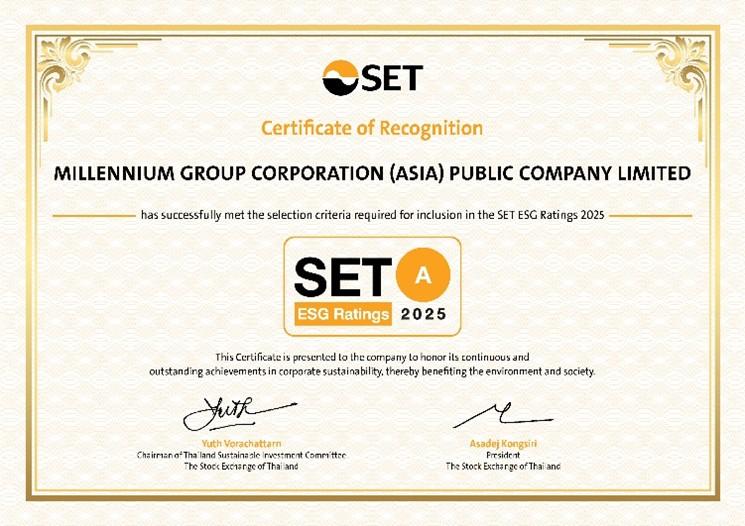
The Company received a SET ESG Rating of “A” for 2025.
The Company was certified as a member of the Thai Private Sector Collective Action Against Corruption on 31 December 2025.
The Company received a score of 98 points in the AGM Checklist assessment conducted by the Thai Investors Association.

As the Company was only recently listed on the Stock Exchange of Thailand, it remains committed to the continuous enhancement of its corporate governance practices. In the coming year, the Company plans to further elevate its corporate governance standards in line with international best practices, enhance the efficiency of transparency-related operations, and strengthen engagement with all stakeholder groups. The Company also intends to further integrate ESG considerations—environmental, social, and governance—into its corporate strategy in order to build a strong foundation for sustainable long-term growth.